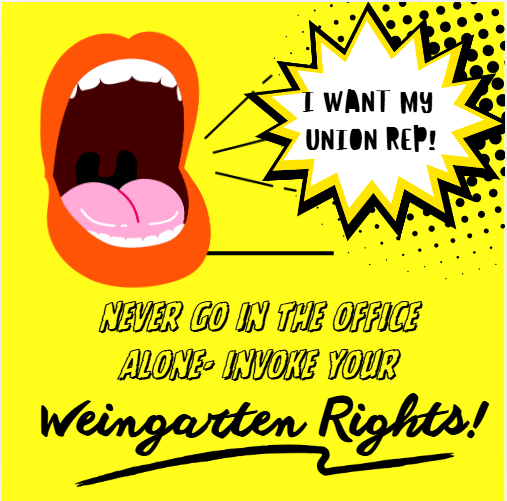
They have a file on every single one of us.
Every conversation.
Every email.
Every tardy.
Every late login.
Every attendance review.
Every audit.
Every prior “informal” counseling.
It’s all compiled, organized, and sitting in a packet before they ever call you down.
And you?
You walk into that office empty-handed. Alone. Completely unprepared.
That’s the imbalance.
By the time you’re called into a meeting, the Department already has the records, timelines, policies, and prior history at their fingertips. Meanwhile, you are expected to recall dates, details, and context from memory, without notes, without copies, and without knowing what evidence they’re relying on. That’s how a “quick conversation” turns into something far more serious.
You’re not a bad employee. You’re a hard worker. You show up. You do your job. You never had a reason to memorize policy manuals or dissect contract language. But suddenly you’re sitting across from management with a packet citing policy violations you’ve never even heard of — policies you were never trained on, never shown, and never given access to in any practical way.
And now you’re expected to defend yourself.
That is a losing fight.
You cannot explain your way out of policy. You cannot justify your way around documentation. You cannot out-argue a prewritten narrative using memory alone. And you absolutely should not try to do it without representation.
This is exactly why Weingarten Rights exist.
Weingarten rights come from the 1975 U.S. Supreme Court case NLRB v. J. Weingarten, Inc., which established that union-represented employees have the right to request union representation during any interview or meeting they reasonably believe could result in discipline. These rights are protected under National Labor Relations Act, and enforced by the National Labor Relations Board.
This right appears in Article 1 of your contract for a reason. It comes before everything else — because without the basic right to representation, none of the other rights in your contract can be effectively enforced, challenged, or grieved.
Your union representative is not there to argue emotions or “vibes.” They are there to:
stop improper questioning
prevent admissions from being used against you
ensure the meeting stays within scope
challenge flawed data or timelines
identify when policy is being misapplied
assert contract protections management may be ignoring
Many times, discipline is based on incomplete, inaccurate, or misinterpreted data, or on policy that your contract limits or overrides. You cannot spot those issues on the fly — but a trained representative can.
One critical thing to understand: management does not have to remind you of your Weingarten rights. If you don’t invoke them, the meeting proceeds without representation, and everything said can be documented and used later.
Even so-called “conversations” or “check-ins” can qualify.
If you reasonably believe a meeting could lead to discipline, you have the right to representation — and you should invoke it every time.
If you fail to plan, you plan to fail.
Do not get caught walking into that office alone.
Invoke your Weingarten rights like your job depends on it — because it does.
Did You Know??
Weingarten Rights – Quick Facts You Should Know
You do not need to be formally disciplined for Weingarten rights to apply. The standard is whether you reasonably believe the meeting could lead to discipline.
Management is not required to warn you of your Weingarten rights. If you don’t ask, they don’t have to offer.
Once you request representation, all questioning must stop until a representative is present. Continuing the discussion is unlawful.
Your supervisor cannot retaliate against you for requesting representation. Doing so is itself a violation.
“This is just a conversation,” “This isn’t disciplinary,” or “You don’t need a rep for this” are not magic words. If discipline is possible, Weingarten applies.
You are not required to answer questions while waiting for representation.
Your representative is allowed to actively participate — not just sit silently.
Even notes taken during an unlawful interview can be challenged and excluded later.
Exercising Weingarten rights does not make you look guilty. It makes you protected.
Now here’s the exact language people should memorize. Short, calm, and legally clean.
What to Say (Use These Words):
“If this meeting could in any way lead to discipline or affect my working conditions, I am requesting union representation. I am not comfortable continuing without my representative present.”
If they keep talking, repeat it:
“I’ve requested representation. I am not answering questions until my representative is here.”
Then stop speaking.
No explanations.
No justifications.
No defending yourself.
Silence after invocation is not insubordination — it is protected activity.
#DontBelieveTheHype
 EVS LIVES MATTER
Leave a comment