WHO ACTUALLY MAKES THE RULES ABOUT ID BADGES?
Lately, there’s been confusion around employee ID badge enforcement in EVS. Some staff have been told that Protective Services policies give authority to enforce stricter rules, override accommodations, or threaten discipline. That is not accurate. To understand why, you have to look at the policy hierarchy. Not all policies carry the same weight. At the top of the hierarchy is Administrative Policy 2904, Standards of Dress and Personal Appearance. This is the governing policy for how employees are required to present themselves at work, including identification badges. Beneath that is Policy 3104, Identification Badges, which applies system-wide to employees. At the bottom of this stack is PS-502, Employee Identification Badges, which is a Protective Services policy that governs how Protective Services Officers carry out their duties. PS-502 does not override the policies above it. It cannot add new requirements, remove existing rights, or expand enforcement authority.
WHAT THE POLICIES ACTUALLY SAY
Administrative Policy 2904 requires that UC Davis Health employees wear their photo identification badge and that it be unobstructed and clearly visible while on duty. It also explicitly allows exceptions for medical, religious, or cultural reasons with appropriate documentation and management approval. Importantly, it states that departmental standards must be clear, consistently enforced, related to safety, and reviewed and approved through proper administrative and labor channels. Policy 3104 reinforces the requirement to wear an identification badge but does not eliminate exceptions, assign enforcement authority to Protective Services, or create disciplinary rules. PS-502 repeats the visibility requirement and adds guidance for Protective Services Officers, such as noting that badges are typically worn on the upper body. However, PS-502 does not mention discipline, does not address accommodations, and does not grant Protective Services authority to override approvals made under higher-level policies.
WHAT PROTECTIVE SERVICES CAN AND CANNOT DO
Protective Services Officers may observe whether an ID badge is visible and report concerns to management. They may remind employees of badge requirements. What they cannot do is invent stricter rules, disregard approved medical or religious accommodations, apply enforcement selectively, or threaten or impose discipline. Discipline, corrective action, and accommodation decisions belong to management and must follow Administrative Policy 2904, labor agreements, and applicable law. A Protective Services operational policy does not change that.
WHY THIS MATTERS
When enforcement suddenly becomes stricter, inconsistent, or punitive without notice, approval, or bargaining where required, it raises serious policy and labor concerns. Administrative Policy 2904 is clear that new or revised standards must be reviewed and approved and properly noticed to employee organizations. Quietly escalating enforcement through a lower-level policy is not how that process works.
THE BOTTOM LINE
PS-502 is an operational policy for Protective Services. It does not create new employee obligations, does not erase accommodations allowed under Administrative Policy 2904, and does not grant disciplinary authority. All ID badge enforcement must remain consistent with system-wide policy, approved exceptions, and labor requirements. Anything beyond that is policy overreach.
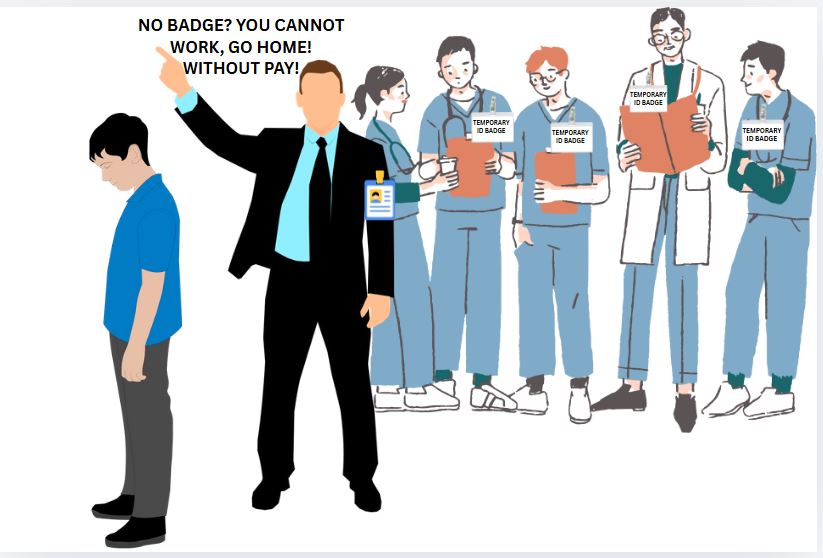
There is also a clear issue of inconsistent enforcement. Other departments routinely allow their staff to obtain temporary day-pass badges from security stations located at hospital entrances when an ID badge is forgotten. EVS staff, however, are not afforded the same option and have instead been sent home without pay. This disparity did not originate with Protective Services. Security stations already issue temporary passes, and the practice exists elsewhere in the hospital. The difference is that EVS leadership chose to apply badge enforcement in a more punitive and selective manner within their own department, effectively cherry-picking one policy out of the broader framework and applying it in a way that disproportionately impacts EVS staff. This kind of selective enforcement undermines claims of neutrality or safety-based justification. When a rule is enforced one way for some departments and an entirely different way for another, it ceases to be a uniform standard and becomes disparate treatment. Policies are meant to be applied consistently across similarly situated employees, not weaponized at the departmental level.
IN CONCLUSION
This issue was never about whether employees should wear identification badges. That requirement has long existed, and EVS staff have never disputed it. The problem is how enforcement was selectively intensified, inconsistently applied, and used in a punitive way against a single department without proper authority, notice, or uniform application. Administrative Policy 2904 establishes the governing standards for dress, personal appearance, and identification badges, including the allowance for documented exceptions and the requirement that enforcement be reasonable, consistent, and properly approved. Protective Services policies do not supersede those standards, and they do not grant disciplinary authority. When enforcement is escalated through a lower-level operational policy and applied differently to one group of workers while others are afforded reasonable alternatives, such as temporary day passes, it crosses the line from compliance into disparate treatment. EVS staff are essential frontline workers who already operate under demanding conditions. Sending employees home without pay for issues that are handled elsewhere in the hospital through temporary, non-punitive solutions is not about safety, professionalism, or policy compliance. It is a choice — one made at the departmental level — to enforce rules in a way that disproportionately harms the very workers relied upon to keep the hospital running. Policies exist to promote safety, consistency, and fairness. When they are cherry-picked, selectively enforced, or stripped of their context, they lose legitimacy. Fair enforcement is not optional, and accountability does not stop at the policy title page.
#DontBelieveTheHype
 EVS LIVES MATTER
Leave a comment